
Being at the Maha Kumbh Mela: Bringing Order Out of Chaos
The maha kumbh mela, just concluded at Prayagraj, is a rare event indeed. Held every 144 years, it is the rarest of the four kinds of kumbh melas, the other three being the purna (every 12 years), the ardh (every 6 years) and the ordinary (every three years) kumbh. While the maha kumbh mela typically includes alignment of four celestial bodies (the sun, moon, Jupiter, and Saturn), this Feb 28 will witness the alignment of all seven planets. Like tens of millions of others, I was fortunate to visit Prayagraj last week and spend some time at the Triveni Sangam.
Now what does the maha kumbh have to do with Beingfulness at all? Well, a lot.
Take the two most popular origin stories. After the gods and the anti-gods (asuras) churned the celestial ocean (Samudra manthan), Dhanvantari, the physician of the gods, emerged with a pitcher (kumbh) containing the elixir of immortality (amrit).
One popular version has it that Jayant, Indra’s son, ran away with this pitcher so that it would not fall into the hands of the asuras. He was protected by the Sun, his son Shani (Saturn), Brihaspati (Jupiter), and the Moon. They ran for 12 days and nights, which correspond to 12 years for us humans. In another version, the supreme god Vishnu, in the avatar of Mohini, the beautiful enchantress, took the pitcher away from the asuras.
In both versions, while the pitcher was being whisked away, some drops fell from the heavens at four places - Haridwar, Ujjain, Prayagraj, and Nashik-Trimbakeshwar. Whoever bathes in the sacred rivers at these places during any of the kumbh melas being held there are said to acquire merit (punya) and be cleansed of their sins.
References to the kumbh mela date back to the Skanda Purana composed by the 8th century CE, and perhaps even the Rig Veda. The Bhakti movement of the 12th century initiated some of the religious rituals, while the Mughal period saw the event become an important social and religious gathering. The mela also became a platform for spreading nationalism after the late 19th century. Nowadays, it has become a vivid reminder of the diversity of people, sects and orders within the vast panoply of sanatana dharma.
Even in this brief history of the kumbh mela, we can identify some important themes that are essential to Beingfulness. First, consider the quest for immortality. From the kumbh’s founding myths, the gods and the anti-gods wanted it badly, and we too can partake of it and become purified. In Beingfulness, this immortal is already in us as the witness self (sakshi). It is beyond time and space and is the ultimate source of our universal values and aspirations. This witness self is the great realization of the Upanishads and the anchor for a beingful way of life. It is also the Being of the western philosophical tradition that reaches beyond Plato to Parmenides and Thales.
A journey to the kumbh mela is therefore a metaphor for the inner journey to discover and anchor in Being, which is the central quest of Beingfulness.
Second, the diversity of the people that come to the kumbh mela testify to the endless ways in which the immortal manifests itself in beings. It is this exhilarating variety of everyday folk drawn from all regions and communities of India that gives the occasion its mela flavoring. It even drew the attention of Xuanzang, a 7th-century Chinese pilgrim, who describes a fair at Prayagraj that resembles the kumbh mela. In my 24-hour timespan comprising late night arrival at Varanasi airport, an early morning trip to Prayagraj, and an evening walk around the Kashi Vishwanath temple, I must have been within touching distance of a million people from thousands of regions and communities across India. Through its surging sea of endless activity, the kumbh mela is a metaphor for the infinite ways in which Being manifests as doing in the world.
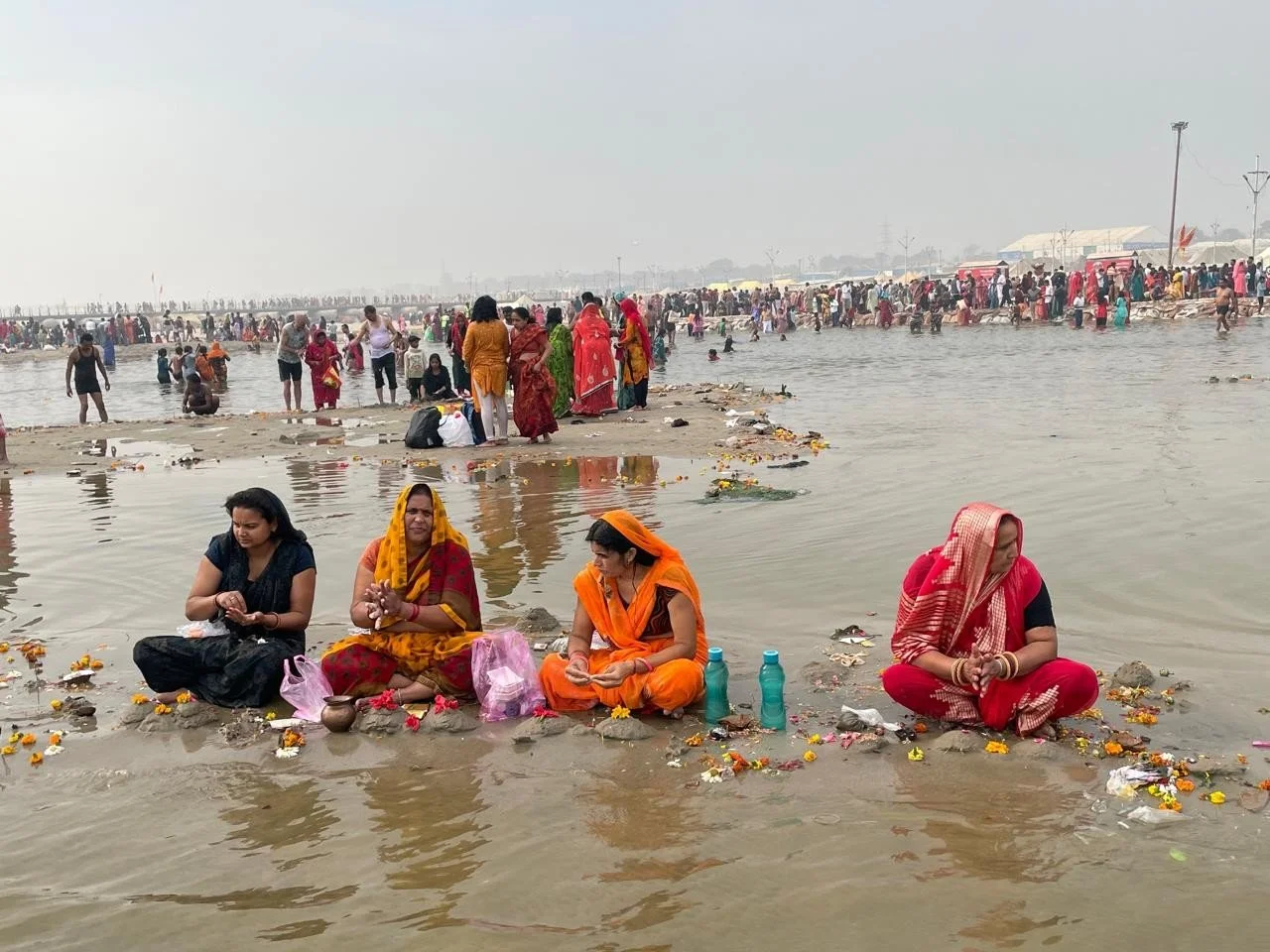
Third, the most awe-inspiring feature of the maha kumbh mela was the complete faith with which people withstood their harsh conditions, whether on foot or in a vehicle. They had come from faraway places through great discomfort and with little means, yet they were patiently waiting through endless hours in the firm belief that they too would get their turn at the river or in the temple. If faith were a currency, then the kumbh mela is the richest neighborhood in the universe. In this way too, it is a metaphor for the deep faith of the lower bird of ego (ahankara) that it will eventually align itself with the higher self or Being through the difficult journey of beingful leadership. Among the many scenes of such faith, I found this photo of four women lined up behind their offerings in the Triveni Sangam to be the most fitting.
Maha Kumbh 2025
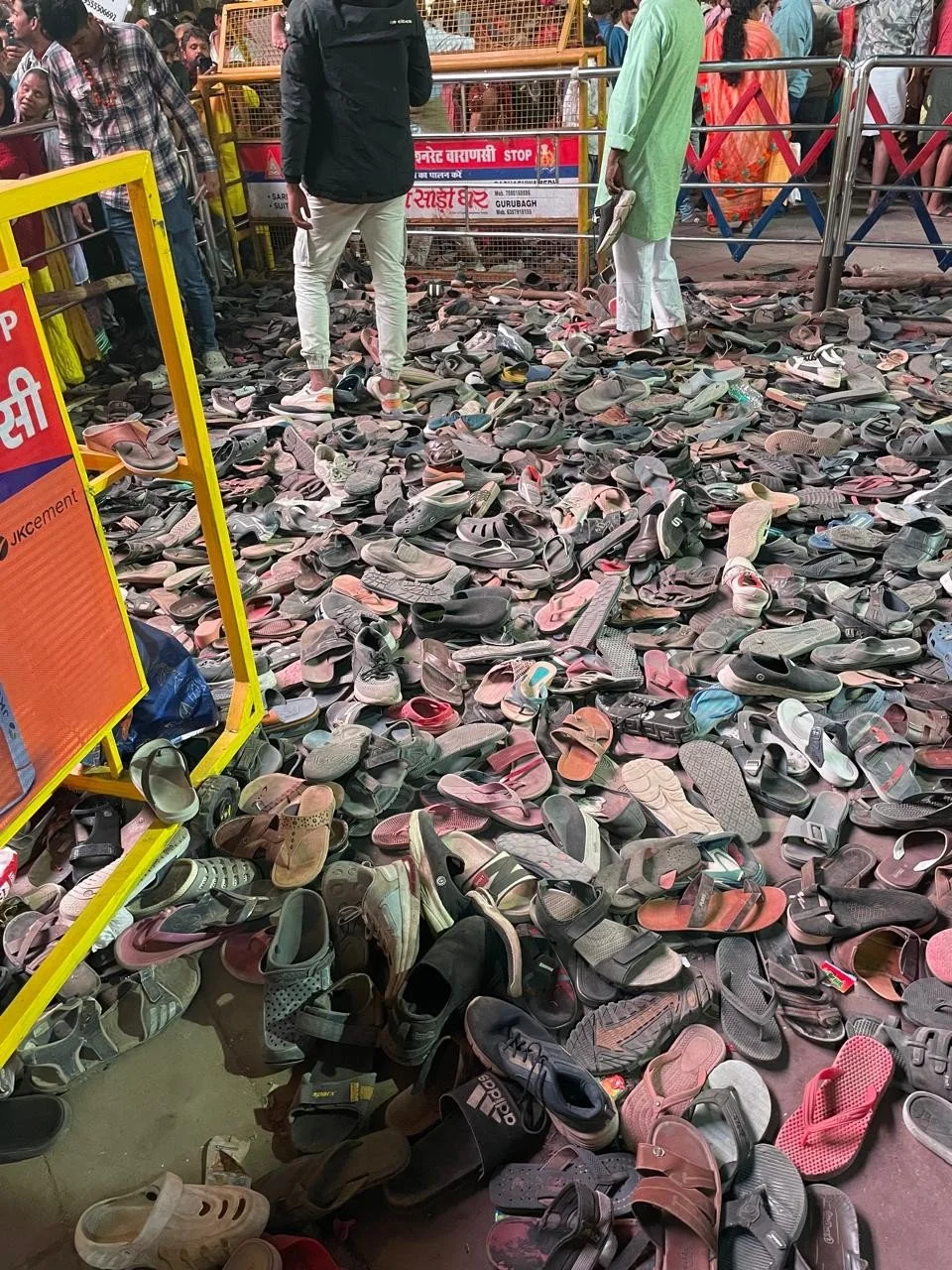
Fourth, despite the many ways in which things could descend into utter confusion, people somehow found a way to create a structure that held together. This surging sea of humanity that could fall apart any moment somehow found a way to make things work, even if it took a while. Despite the many roadblocks and traffic jams that made driving into Prayagraj a nightmare, there were enterprising motorcycle riders who could let you cut through the traffic and get you to where you wanted to go. Despite the challenges of finding clean public toilets, people somehow had the internal fortitude to hold it in while moving about. In Varanasi, despite the teeming throngs that barely gave you room to breathe, people somehow stayed in their heaving lines and eventually managed to get into the Kashi Viswanath temple. And despite the enormity of the challenge in searching through a chaotic mess of leather and rubber, such as the one below, people somehow managed to retrieve their own footwear.
Footwear at Maha Kumbh 2025
This then is the final metaphor linking the kumbh mela to Beingfulness. Behind the infinite variety of ways in which Being manifests itself in the world, there is an underlying unity that leads to order. This unity in diversity describes a hidden wholeness that keeps everything in balance. Just as the drops from the divine kumbh fell in four sacred places, and just as the four celestial objects protected the immortal elixir, so too do the four kinds of capital that underly all the varieties of capital, i.e., material, human, social, and natural, need to be in balance to enable wholeness.
Ultimately, the kumbh mela is a metaphor for the order out of chaos that is the goal of Beingfulness.